
Industrial floors have to do more than look good. They need to withstand demanding working conditions, heavy traffic, equipment, spills, chemicals, impacts, and constant daily use without becoming a maintenance problem.
Our industrial coating systems are designed for facilities that need a durable, practical, and professionally finished concrete floor. Depending on the environment and performance requirements, we can recommend coating solutions suited to warehouses, workshops, manufacturing areas, commercial facilities, service areas, utility spaces, and other demanding applications.
The right industrial floor coating is not simply about choosing the hardest material available. The system needs to match the concrete, the working environment, the type of traffic, chemical exposure, cleaning requirements, and the expectations of the facility.
What Are Industrial Floor Coatings?
Industrial floor coatings are protective systems installed over concrete to improve the performance, appearance, and maintainability of the existing floor.
Different systems can include epoxy coatings, high-build epoxy, polyaspartic coatings, urethane topcoats, and other resin-based flooring solutions. The appropriate system depends on how the floor will be used.
A warehouse with forklift traffic has different requirements from a manufacturing facility exposed to chemicals. A service area may need excellent resistance to oil and automotive fluids, while a food or commercial facility may prioritize cleaning and sanitation.
That is why we approach every industrial flooring project based on the actual environment rather than recommending the same coating for every application.
Benefits of Industrial Concrete Coatings
A properly designed and installed industrial flooring system can provide several important advantages.
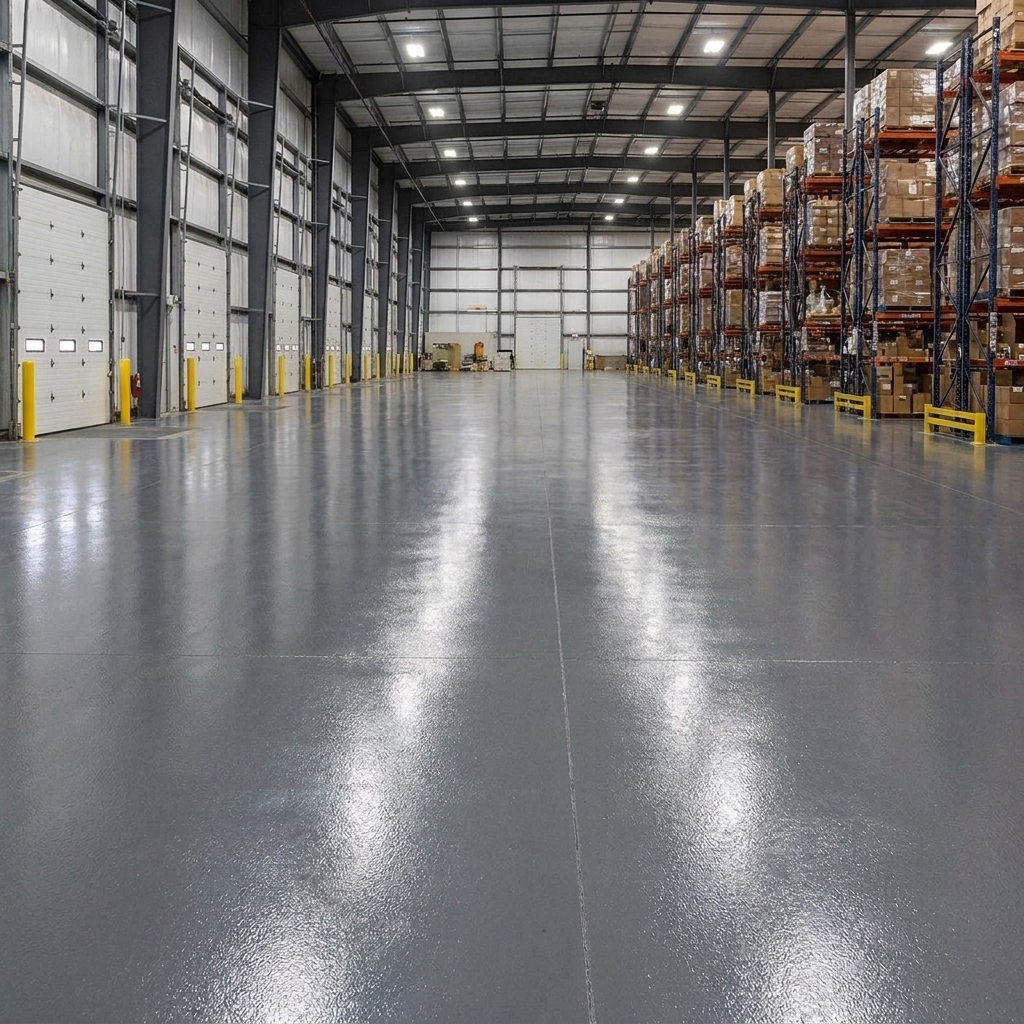
Protection Against Heavy Traffic
Industrial floors can experience constant movement from employees, vehicles, carts, pallet equipment, forklifts, and machinery.
A suitable coating system can provide an additional protective layer over properly prepared concrete, helping the floor handle the demands of regular traffic.
The coating needs to be selected according to the expected loads and conditions rather than simply advertised as a universal heavy-duty solution.
Resistance to Chemicals and Spills
Many industrial environments regularly encounter oils, solvents, cleaning products, chemicals, and other liquids.
The resistance of a finished floor depends on the specific coating products and exposure involved. During the planning stage, we consider what substances the floor may encounter and how frequently exposure occurs.
Choosing a system based on the actual chemical environment can help prevent premature deterioration and unnecessary repairs.
Easier Cleaning and Maintenance
Uncoated concrete can absorb spills and collect dirt in cracks, pores, and damaged areas. A properly sealed industrial coating creates a more uniform surface that can make routine cleaning easier.
This can be especially valuable in facilities where floors need to be cleaned frequently or where keeping the work environment organized is important.
A floor that is easier to maintain can also help reduce the time employees spend dealing with avoidable cleaning problems.
Industrial Epoxy Flooring
Epoxy remains a popular choice for many industrial flooring applications because it can provide a hard, durable surface when installed correctly.
Industrial epoxy systems can be customized according to the environment, including the number of coating layers, aggregate options, thickness, colour, and protective topcoat.
The finished system can provide a clean and professional appearance while protecting the underlying concrete from many forms of everyday wear.
However, epoxy isn’t automatically the right choice for every industrial facility. Temperature, UV exposure, moisture, chemical contact, traffic, curing requirements, and installation conditions all need to be considered.
Polyaspartic and Hybrid Coating Systems
In some industrial and commercial environments, polyaspartic coatings or hybrid systems may offer advantages over a conventional epoxy-only installation.
Polyaspartic systems can provide fast curing and strong resistance to UV exposure, making them useful for certain applications where reduced downtime or sunlight resistance is important.
A hybrid flooring system may combine different coating technologies to take advantage of their individual characteristics.
The best solution depends on the facility. We can evaluate the conditions and recommend a system based on performance requirements rather than choosing a material simply because it is popular.
Concrete Preparation Comes First
One of the biggest mistakes in industrial flooring is treating surface preparation as an optional step.
A coating can only perform as well as the surface and installation underneath it allow. Concrete may contain oil contamination, dust, previous coatings, cracks, weak areas, moisture, or other conditions that can interfere with adhesion.
Depending on the project, mechanical preparation such as diamond grinding may be required to remove contaminants and create the appropriate surface profile.
Cracks and damaged areas should also be evaluated before the coating is applied.
Our approach is straightforward: identify problems with the concrete before covering it. This helps reduce the risk of installing an expensive flooring system over an unsuitable surface.
Industrial Floors Designed for Your Environment
Every industrial facility operates differently.
Some floors deal primarily with forklift and vehicle traffic. Others experience constant pedestrian traffic, machinery vibration, chemical exposure, grease, impact, or frequent cleaning.
Before selecting a coating system, we consider factors such as:
- Type and amount of daily traffic
- Forklift and equipment use
- Chemical and oil exposure
- Impact and abrasion
- Cleaning methods
- Moisture and humidity
- Temperature conditions
- UV or sunlight exposure
- Required slip resistance
- Expected service life
- Available installation and curing time
These factors help determine which combination of preparation, coating layers, aggregates, and topcoats makes sense for the project.
Safety and Slip Resistance
A smooth-looking floor isn’t necessarily the safest floor for every industrial environment.
Areas exposed to water, oil, chemicals, or frequent spills may require additional slip resistance. Aggregate can be incorporated into certain coating systems to provide additional texture underfoot.
The appropriate level of texture depends on the working environment and cleaning requirements. Too little texture may provide insufficient traction, while excessive texture can make cleaning more difficult.
The goal is to balance safety, maintenance, and performance for the specific facility.
Minimizing Industrial Flooring Downtime
For many businesses, taking a working area out of service can be costly.
That’s why installation planning is an important part of an industrial flooring project. We consider the size of the area, preparation requirements, coating system, curing times, access restrictions, and how the facility operates.
Depending on the coating system selected, some floors can be returned to service faster than others.
Rather than promising an unrealistic one-size-fits-all installation time, we work around the actual requirements of the project and explain what needs to happen before the floor can safely handle its intended traffic.
A Professional Finish for Industrial Facilities
Industrial flooring doesn’t have to look neglected simply because it is designed for heavy use.
A professionally installed coating can give warehouses, workshops, manufacturing spaces, service areas, and commercial facilities a cleaner and more organized appearance.
Colour can also be used strategically to improve the visual layout of a facility, identify work zones, or create a more consistent appearance throughout the building.
Is Industrial Coating Right for Your Facility?
If your existing concrete is becoming difficult to clean, showing signs of excessive wear, absorbing spills, producing dust, or struggling with daily traffic, an industrial coating system may be worth considering.
The first step is evaluating the existing floor and understanding what it needs to handle.
We can assess the concrete, discuss the operating conditions, identify preparation requirements, and recommend a coating system suited to the facility.
Get a Quote for Industrial Floor Coatings
Your industrial floor is part of your working environment. It needs to support your operation rather than become another source of maintenance and downtime.
Whether you need a durable epoxy system for a workshop, a high-performance coating for a warehouse, or a customized flooring solution for a commercial or industrial facility, we can help determine the right approach.
Contact us today to discuss your industrial flooring requirements and request a professional quote.