

Yes—epoxy flooring can work very well in cold climates, including Thunder Bay and Northwestern Ontario. But it is not automatically successful just because a product is labelled “epoxy.” In our experience at Thunder Bay Epoxy, the difference between a floor that lasts and one that peels, bubbles, or wears prematurely usually comes down to moisture, surface preparation, installation conditions, and choosing the right system for the space.
Thunder Bay winters create a demanding environment for concrete floors. Snow, slush, road salt, standing water, repeated wet-dry cycles, and freeze-thaw conditions all place stress on a garage, basement, workshop, or commercial floor. Epoxy can handle those conditions when the concrete and installation are properly managed.
Why Cold Climates Are Hard on Concrete Floors
Cold weather does not automatically prevent epoxy from working. However, it introduces conditions that can expose weaknesses in the concrete or in the installation process.
In Thunder Bay, the most important issues we see are:
- Moisture vapour moving through the concrete slab
- Snow, water, and road salt tracked in from outside
- Repeated freeze-thaw cycles
- Oil, tire residue, and salt contamination on older garage floors
- Cold slab temperatures during installation and curing
- Hot-tire pickup when a coating has not bonded properly
- Cracks, surface wear, or previous coating failures that were not addressed
A coating is only one part of the finished floor. The concrete beneath it, the preparation process, and the conditions during installation all determine how the system performs over time.
The Biggest Causes of Epoxy Failure in Thunder Bay
After working on residential garages, basements, workshops, utility areas, and commercial spaces, we have found that most epoxy problems are not caused by the epoxy itself. They are caused by issues that were missed before or during installation.
Moisture in the Concrete
Moisture vapour is one of the biggest concerns, especially in garages and basement slabs. Concrete can look dry on the surface while still allowing moisture to move through it from below.
If excessive moisture is trapped beneath an impermeable coating, it can create pressure under the floor. Over time, that pressure can lead to bubbling, blistering, peeling, or loss of adhesion.
We always assess the concrete before recommending or applying a coating. If the slab shows signs of moisture concerns, the issue needs to be addressed before coating—not after the floor starts to fail.
Inadequate Surface Preparation
Epoxy needs a clean, sound, properly profiled concrete surface to bond to. If the slab still has oil, salt, dust, old coatings, weak concrete, or surface contamination, the epoxy may not develop a reliable mechanical bond.
Grinding and thorough cleaning are critical on many projects. Acid etching can be useful in certain situations, but mechanical preparation gives much more control over the surface profile and is generally our preferred approach for demanding garage floors.
Poor Installation Conditions
Temperature matters more than many homeowners realize. Applying epoxy when the slab or surrounding environment is too cold can slow curing and interfere with adhesion.
We do not rely only on the outdoor temperature. We monitor the concrete temperature, humidity, and the coating manufacturer’s application requirements. Each coat also needs enough time to cure properly before the next stage is applied.
Winter Contamination
Road salt, de-icing chemicals, water, and repeated wet-to-dry cycles can be hard on any floor coating—especially one that was poorly prepared or installed. In garages, hot tires can also pull at a coating that has not bonded properly or that is not suited for vehicle traffic.
This does not mean epoxy is a poor choice for a Canadian garage. It means the system must be selected and installed with winter use in mind.
A Real Thunder Bay Garage Example
One project that shows how epoxy can succeed in a cold climate was a residential garage in Thunder Bay of approximately 500 square feet.
The homeowner wanted a durable, easy-to-clean floor that could handle vehicles, winter snow, road salt, and the moisture that regularly enters a garage during colder months.
The existing concrete was structurally sound, but it had several small cracks, surface wear, and areas of oil and salt contamination from years of vehicle use. Before applying anything, we:
- Cleaned and degreased the slab
- Mechanically prepared the concrete to remove contaminants and create the proper surface profile
- Repaired cracks before coating
- Paid extra attention to salt and moisture buildup near the garage entrance
- Assessed moisture conditions before proceeding
- Kept the garage within the coating manufacturer’s recommended temperature and humidity range
- Allowed each coat to cure properly before moving to the next stage
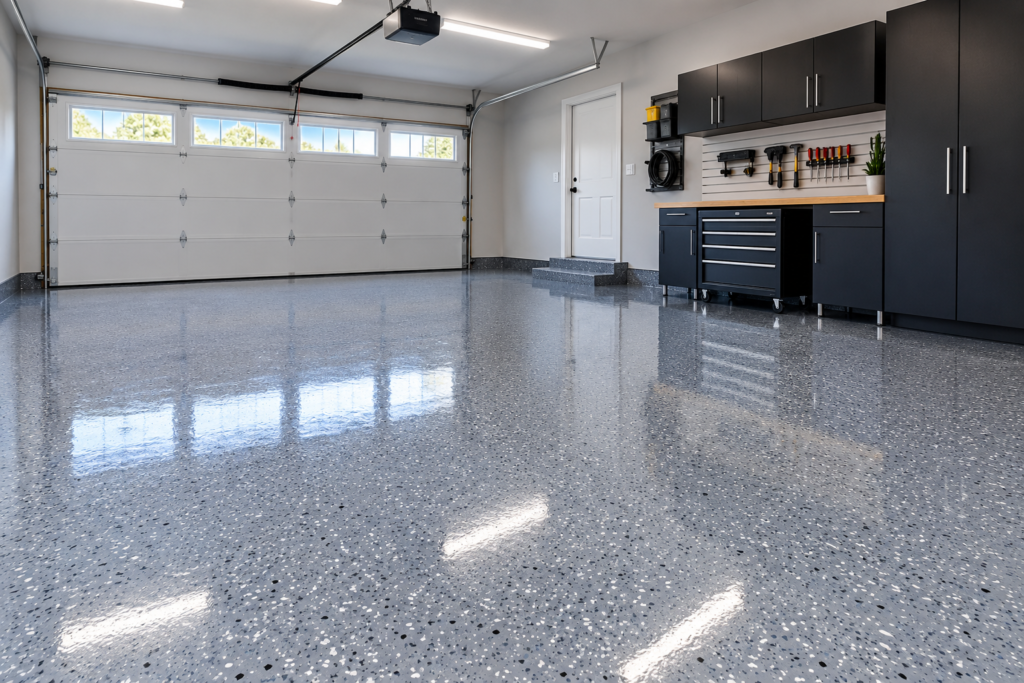
For the finish, we used a professionally installed multi-coat epoxy system with a decorative flake broadcast and a protective clear topcoat. The flake finish provided texture, helped hide everyday dirt and minor marks, and created a more practical surface for a garage. The clear coat added resistance to abrasion, chemicals, salt, and regular vehicle traffic.
That floor has continued to perform well through winter conditions, including snow, water, road salt, and regular vehicle use.
The biggest lesson from that project is simple: the longevity of an epoxy floor starts before the epoxy is ever applied.
Does Epoxy Always Peel in Canadian Garages?
No. We disagree with the claim that epoxy always peels in Canadian garages.
Epoxy does not automatically fail because a garage is in Canada. Peeling is usually related to one or more of the following:
- Inadequate surface preparation
- Moisture vapour in the concrete
- Oil, salt, or other contamination left on the slab
- Installation in conditions that were too cold or humid
- Using a coating system that is not appropriate for the application
- Applying a new coating over a poorly prepared existing coating
A properly prepared concrete slab and correctly installed coating system can perform very well through Canadian winters.
Are DIY Epoxy Kits a Good Idea?
Sometimes—but not always.
A DIY epoxy kit can make sense for a homeowner who has a clean, dry, relatively new slab and wants an economical cosmetic improvement. If the concrete is in good condition and the space will not see heavy vehicle traffic, chemicals, or significant winter moisture, a simpler system may be perfectly reasonable.
However, older garages are often less forgiving. If the slab has oil contamination, previous coatings, cracks, moisture concerns, or heavy winter use, preparation and product selection become much more important.
Good preparation is essential, but it is not the only factor. The right coating system, proper application conditions, and adequate curing time all matter.
Is Acid Etching as Good as Diamond Grinding?
Not in our experience.
Acid etching can be a reasonable option for some clean, bare concrete surfaces, particularly when budget is a major consideration. But it does not give the same level of control as mechanical diamond grinding.
For demanding garage floors, we generally prefer mechanical preparation when the slab and project conditions allow it. Grinding helps remove surface contamination and weak material while creating a more consistent profile for the coating to bond to.
Do More Coats Always Mean a Better Floor?
Definitely not.
A thicker or more complicated coating system is not automatically better. What matters is whether the system is properly designed for the substrate, traffic, moisture conditions, chemicals, temperature, and intended use.
Adding unnecessary coats can increase cost without solving the underlying problem. We would rather install the right number of properly prepared and properly cured coats than sell a homeowner material they do not actually need.
Is Polyaspartic Always Better Than Epoxy in Cold Climates?
No. That claim is too simplistic.
Polyaspartic systems have excellent properties, including fast curing and strong UV and chemical resistance. They can be a great choice in certain applications.
But that does not mean polyaspartic is automatically the right choice for every Thunder Bay garage or basement. Epoxy can still be an excellent option when the system is properly selected and installed.
The right choice depends on:
- The condition of the concrete
- Moisture levels in the slab
- Expected traffic and vehicle use
- Exposure to salt, water, and chemicals
- Temperatures that can be maintained during installation and curing
- Budget
- Desired appearance and finish
When a Basic Epoxy System Makes Sense
We do not believe every homeowner needs the most expensive coating system.
A basic epoxy system may be a sensible choice when:
- The concrete is structurally sound
- The slab is relatively new, clean, and dry
- There are no major cracks or previous coating failures
- Moisture is not a concern
- The floor will see light to moderate use
- The homeowner wants a cosmetic improvement at a lower cost
In those situations, a simpler system can be a practical and economical option.
When a More Durable System Makes Sense
A multi-coat professional system is often the better choice when the floor will face tougher conditions.
Consider a more durable system if:
- The garage sees regular vehicle traffic
- Snow, slush, and road salt enter the space every winter
- The slab has cracks, surface wear, or contamination
- The floor needs resistance to oil, chemicals, and abrasion
- The homeowner wants a decorative flake finish and protective clear coat
- The concrete has conditions that require more thorough preparation
The goal is not to upsell. The goal is to match the system to the actual conditions of the concrete and the way the space will be used.
Questions to Ask Before Installing Epoxy
Before choosing an epoxy floor, homeowners should understand the condition of their concrete and how the space will be used.
Ask these questions:
- Is the concrete structurally sound?
- Is there evidence of moisture or previous coating failure?
- Are there oil, salt, or chemical contaminants on the surface?
- Are there cracks or damaged areas that need repair?
- What temperatures can be maintained during installation and curing?
- Will the floor see vehicles, heavy equipment, chemicals, or significant winter moisture?
- Is a basic epoxy system enough, or would a more durable multi-coat system make sense?
These questions matter more than simply comparing colours, brands, or price per square foot.
Our Recommendation for Thunder Bay Homeowners
Epoxy flooring can absolutely work in Thunder Bay’s cold climate. We have seen properly installed systems perform well through snow, moisture, road salt, and repeated winter use.
But an epoxy floor should be treated as a complete system, not just a coating colour. Proper moisture assessment, mechanical preparation, contamination removal, crack repair, temperature control, and adequate curing are just as important as the epoxy itself.
If you are considering epoxy flooring for a Thunder Bay garage, basement, workshop, or commercial space, have the concrete assessed before choosing a coating. Thunder Bay Epoxy can look at the condition of the slab, identify moisture or preparation concerns, and recommend a system suited to your space, climate, expected use, and budget.
The goal is not to convince every homeowner to buy the most expensive system. The goal is to help you choose a floor that will actually last.