

A few winters ago, a homeowner preparing to list their mid-1980s split-level near Westfort came to us with a stained, dusty garage floor and a skeptical expression. They’d gotten a quote for a decorative flake epoxy system but were hesitating.
“It’s just a garage,” they told us. “Buyers won’t care. I can clean it and save the money.”
They weren’t alone. Most homeowners we talk to see epoxy as a cosmetic upgrade at best, a pretty floor for a room that’s mostly used to store a truck and a snowblower. They assume the value conversation is simple: either the appraiser adds a number, or it doesn’t.
The truth is more nuanced than that, and it’s where this post gets interesting. After years of installing epoxy floors in Thunder Bay homes and basements, we’ve watched how these floors actually play out at inspection, at showing, and at closing. What we’ve learned doesn’t always match what you’ll read in generic “epoxy ROI” articles.
Here’s the honest picture from where we stand.
Why We Push Epoxy in Our Own Homes
The primary motivation isn’t aesthetics. It’s durability and low maintenance in a harsh Northern Ontario climate.
In Thunder Bay, garage and basement floors take a beating that most of Canada’s southern markets don’t see. We’re talking freeze-thaw cycles, road salt, wet snow tracking in on boots, oil drips from trucks, and heavy equipment moving across the slab year-round.
Epoxy checks the boxes we actually care about day to day:
- It resists chemicals, salt, and impact far better than bare concrete or floor paint. When you’re scraping salty slush off a truck, the floor needs to handle it without absorbing it.
- Spills, mud, and tracked-in grit wipe or mop up instead of grinding into porous concrete.
- With anti-slip additives and a clean, bright finish, the space feels like a usable room rather than a dusty slab.
That combination, toughness against Northern weather plus a floor that actually stays clean, is the core reason we install epoxy in our own homes and recommend it to Thunder Bay homeowners.
The Surprise Most Homeowners Don’t Expect
Most homeowners expect the hard part to be choosing colours or waiting for it to dry. They walk in thinking the decision is about whether they want blue flakes or a metallic grey.
In reality, the single biggest challenge is the condition of the concrete and getting it properly prepared and moisture-tested before any epoxy goes down.
What catches people off guard:
- Roughly 80% of epoxy failures trace back to poor surface prep. If the slab isn’t mechanically profiled (ground or shot-blasted) and thoroughly cleaned, the coating has nothing to bond to and will delaminate.
- Moisture vapor from the slab is a silent killer. In older Thunder Bay homes and garages, moisture pushing up through the concrete can blister or lift the epoxy even when the surface looks bone-dry to the eye.
- Proper prep, repairs, and curing mean the garage or basement is out of commission for several days, often longer in cold or humid conditions.
The “surprise” for many homeowners is discovering their slab needs crack repairs, degreasing, grinding, and sometimes moisture mitigation before the decorative part even starts. Skipping or rushing this step is what causes peeling, bubbling, and hot-tire pickup later.
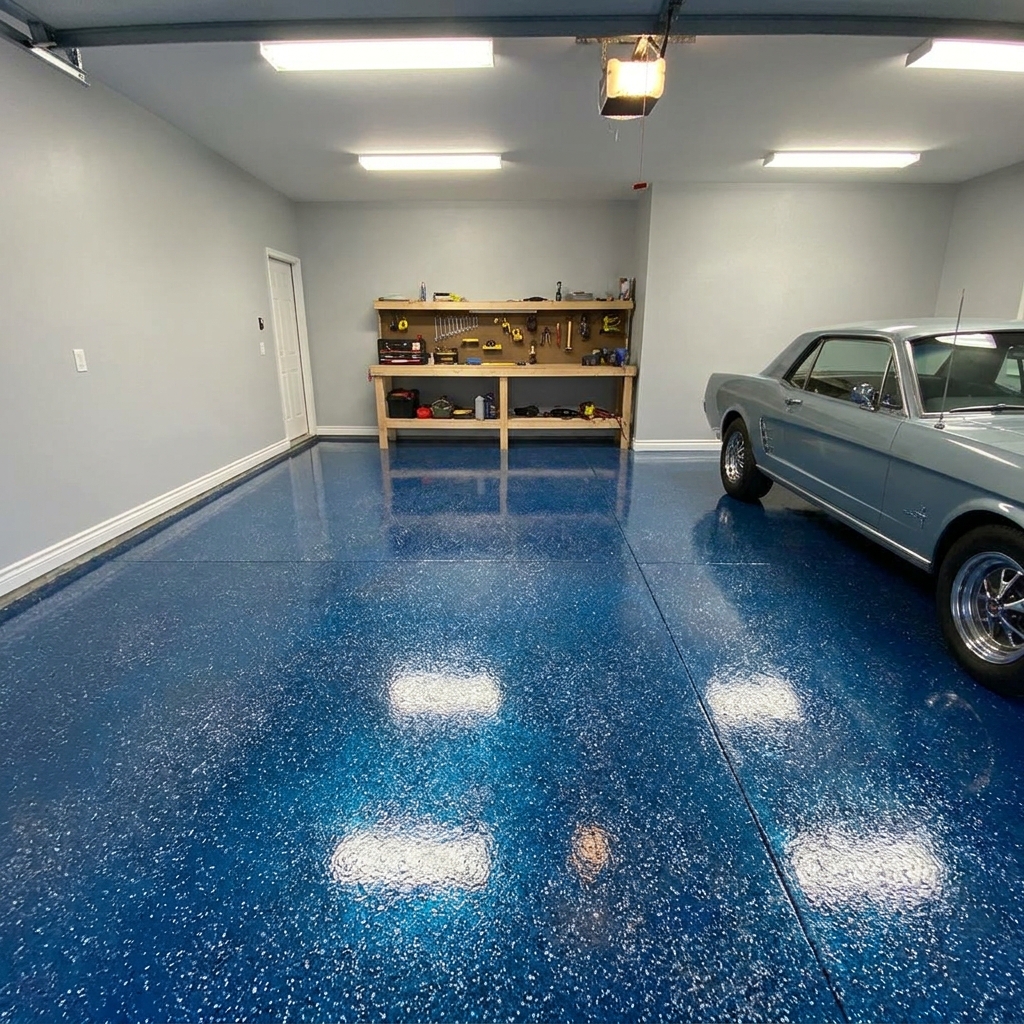
A Real Example: When the Value Became Undeniable
Let’s go back to that split-level near Westfort.
The garage was typical for the area: oil stains, tire marks, winter salt damage, patches of old peeling paint, visible hairline cracks, and a damp spot near the back wall after heavy rain. The homeowner’s view was clear: “I can clean it and save the money.”
Their main concerns were cost versus benefit, timing (they were already juggling painting, minor repairs, and staging), and perception. They believed epoxy was purely a visual upgrade, not something that would affect the sale.
What We Did
We reframed the conversation. Instead of talking about how the floor would look, we talked about how a finished garage floor plays in a Thunder Bay sale, especially with picky buyers and home inspectors.
We walked them through what inspectors and savvy buyers look at in a garage slab:
- Moisture issues and efflorescence
- Unsealed concrete that’s absorbing oil and salt
- Cracks that suggest drainage or grading problems
A properly installed epoxy system signals that the slab has been assessed, prepared, and sealed. It reduces red flags before they become negotiation points.
Before quoting, we did a visual and moisture-vapor assessment using a plastic mat test and surface readings. We identified the damp area near the back wall as likely surface condensation plus minor vapor drive, not a major structural leak. We recommended crack injection and a moisture-tolerant primer in that zone before the full epoxy coat.
That turned a potential “garage slab concern” on an inspection report into a documented, addressed item.
For the install itself, we used mechanical grinding for proper profile (no acid etch shortcuts), crack repair and spot moisture mitigation, a base coat with decorative flakes, and a clear topcoat with anti-slip additive.
We also gave the homeowner before/after photos for their realtor to use in the listing, plus a one-page summary of the work — prep, moisture steps, products, warranty — to show during showings and inspections.
What Happened at Inspection and Sale
The buyer’s inspector noted the garage floor as a positive: no active moisture issues, no spalling, and a sealed surface that would be easy to maintain. The previously damp-looking corner was called out as “previously addressed; no current evidence of active leakage.” That removed a common negotiation point before it could become one.
During showings, the listing agent reported multiple comments along the lines of: “The garage actually feels like part of the house” and “I don’t have to budget for a floor redo right away.” In a market where many garages are stained and dusty, that stood out.
The measurable outcomes:
- The home sold faster than comparable listings in the same price band. Other agents noted the finished garage as a differentiator.
- The seller avoided a post-inspection credit request for garage floor condition. We’ve seen those concessions knock $1,500 to $3,000 off deals in similar properties when the slab looks neglected.
- In practical terms, the epoxy cost was a fraction of the potential concession they would have faced if the garage had been flagged as “needs work.”
This is the pattern we see over and over: homeowners start out thinking epoxy is just cosmetic, but when an inspection or offer moment arrives, the real value shows up as fewer objections, stronger buyer confidence, and a smoother path to closing.
Where the Value Is Real in a Thunder Bay Sale
Based on what we’ve seen locally, the value from a proper epoxy floor is strongest in three areas.
Reducing Inspection and Negotiation Risk
Thunder Bay buyers and inspectors are attuned to moisture, salt damage, and spalling in garages and basements. Cracked, stained slabs suggest neglected maintenance. A professionally installed epoxy system with documented prep, crack repair, and moisture steps turns a potential concern into a non-issue on the inspection report. That directly protects your deal from requests for price reductions or credits, and from buyers mentally pricing in a “we’ll have to redo the garage floor” contingency.
Avoiding even one $2,000 to $3,000 concession can cover most epoxy installs.
Improving Perceived Condition and Move-In Readiness
Northern Ontario buyers are pragmatic. They want homes that feel maintained and ready for winter. A clean, bright, sealed garage floor signals that the owner cared about the whole property, not just the visible rooms. It makes the garage feel like usable, intentional space rather than a dusty utility slab. And it shows well in listing photos, especially compared to the typical stained, salt-crusted concrete you see across our market.
That “this place has been looked after” impression is where a lot of the real value lives.
Shortening Time on Market in a Competitive Segment
In mid-range Thunder Bay listings where several homes look similar on paper, small differentiators matter. A finished garage can generate more showing requests, create a memorable positive impression during tours, and help your home stand out against others with bare, worn slabs. Industry observations suggest finished garages can help homes sell 10 to 20% faster. Locally, we see that as fewer weeks of carrying costs and uncertainty, which is a tangible financial benefit.
Where the Value Is Overstated
Most national or U.S.-centric “ROI” articles overpromise in a few key ways, and we want to be straight with you about where the hype doesn’t hold up in Thunder Bay.
The “50 to 75 Percent ROI” Myth
You’ll see claims like “60 to 80% direct ROI” or “adds $5,000 to $10,000 in perceived value” or even “ROI of 120 to 150 percent.” Those numbers are usually based on specific markets (often warmer, higher-price regions), tied to ideal conditions (perfect slabs, high-end installs, hot seller’s markets), and not broken out in any major national appraisal database for garage coatings specifically.
In Thunder Bay, appraisers rarely assign a line-item value for epoxy. The gain is indirect: better condition rating, fewer concessions, faster sale. Not a guaranteed dollar amount added to the appraisal.
“Adds 5 to 15 Percent to Home Value” Without Context
Statements like that ignore the wide price range of Thunder Bay homes, the relatively small cost of a garage floor compared to the whole property, and the fact that most buyers won’t base their entire offer on the garage alone. In reality, epoxy might shift a buyer’s perception enough to justify the asking price or tip a close call in your favour, but it seldom moves the needle by a full percentage band of the home’s value.
Treating All Epoxy Installs as Equal
Generic articles often assume proper mechanical prep, crack repair, moisture testing, and experienced installers. But many homeowners use cheap DIY kits, skip prep or just acid-etch, and coat over old paint or damp concrete. Those jobs can fail within a few years, which can actually hurt perceived value at sale time. The “ROI” stories rarely account for bad installs.
When We Tell You Not to Bother
This is the section most epoxy companies won’t write. But honesty builds trust, and we’d rather tell you “don’t bother” than sell you a system that fails in two winters.
Here are the situations where we push back.
Active Moisture or Hydrostatic Pressure
If your concrete shows persistent damp spots, efflorescence, blistering paint, a history of water seepage after heavy rain or snowmelt, or failed plastic-mat moisture tests, we won’t put a standard epoxy film over it without fixing the underlying issue first. Epoxy traps moisture. Vapor pressure then lifts the coating, causing bubbles, blisters, and delamination.
What we recommend instead: address drainage, grading, or interior waterproofing first. If you want a finished look now, use a breathable penetrating sealer or a moisture-tolerant primer with a polyaspartic or polyurea system designed for higher vapor transmission, not a thick 100% solids epoxy film.
Structurally Unsound or Badly Cracked Concrete
Epoxy is not a structural fix. If your slab has moving cracks, spalling, pop-outs, major unevenness, or heaving from frost or poor subgrade, coating it with epoxy just makes the problem more visible when it cracks through again.
What we recommend instead: prioritize concrete repair and leveling. For rough utility spaces, a grind plus densifier or polished concrete approach, or a heavy-duty polyurea or polyaspartic system with crack-bridging capability, may be more honest than a decorative epoxy that telegraphs every movement.
UV-Exposed or Sun-Drenched Garages
Traditional epoxy yellows and chalks under UV exposure. In Thunder Bay this matters less than in southern climates, but it’s still an issue in garages with large windows or glass-pane doors, or spaces where the door is often open in summer.
What we recommend instead: use polyaspartic topcoats (UV-stable) over an epoxy base if you want the decorative flake look with better UV resistance. For fully exposed areas, go with a full polyaspartic or polyurea system.
Tight Timelines and Cold-Weather Constraints
Epoxy has real cure-time and temperature limits. Vehicles typically must stay off for 5 to 7 days. Most epoxies shouldn’t be applied below about 10 degrees Celsius. Cold, damp Thunder Bay falls and springs can stretch cure times and increase failure risk.
If you need the garage back in service in 24 to 48 hours, polyaspartic or polyurea systems are the smarter call. They can be walked on in hours and driven on in one to two days, and they tolerate a wider temperature and humidity window.
Budget That Only Covers “Cheap Epoxy” and No Real Prep
If your budget only allows acid etch instead of mechanical grinding, no crack repair or moisture testing, or a thin DIY-style kit over old paint, the result is usually a short-lived coating that peels with hot tires or winter salt. We’d rather be honest.
What we recommend instead: start with a good concrete cleaner and penetrating sealer to reduce dust and staining. Plan for a proper coating later, once repairs and prep are in budget. In some utility garages, a high-quality concrete paint (understanding it’s temporary) is a more honest match to the budget than a “premium epoxy” job cut to the bone.
Expectations That Epoxy Will “Fix Everything”
We also push back when the expectation is that epoxy will stop all future cracking, hide major moisture problems, or make a rough, pitted slab perfectly smooth without repair. Epoxy enhances and protects a sound slab. It doesn’t rewrite the concrete’s history.
What we recommend instead: a clear conversation about what epoxy can and can’t do, then either invest in the needed repairs and a proper system, or choose a lower-cost, lower-expectation solution until a larger renovation makes sense.
The Honest Reframe: Insurance Against Value Loss
Here’s the one thing we wish every Thunder Bay homeowner understood before they start reading ROI articles.
The biggest mistake in the “does epoxy add value” conversation is framing it as “you will get $X back at closing.” That’s the wrong question.
The more honest and useful frame is: epoxy is insurance against value loss, not a guaranteed value add.
Its main financial role is to prevent discounts, credits, and delays that would otherwise come off your net proceeds. It protects your asking price by removing a visible objection and reinforcing a well-maintained image. The “return” shows up as a cleaner inspection, stronger buyer confidence, and fewer last-minute negotiations, not as a separate line on the appraisal.
For a Thunder Bay homeowner, the right question isn’t “Will the appraiser add $3,000 for my epoxy floor?”
The right question is: “If I list with a stained, cracked garage slab, how much will I likely give back in concessions, price cuts, or extra carrying costs, and would a proper floor coating reduce that risk enough to justify the cost?”
Answered that way, epoxy often clears the bar. Even if no one ever writes “epoxy garage floor: plus $X” on the appraisal.
What We Want You to Do Next
We don’t want you to call us just to “get a price.” We want you to book a proper slab assessment first.
Concretely, here’s what that looks like:
- Request a pre-quote moisture and slab assessment, not just a drive-by estimate.
- Bring any known history: past water issues, when the garage was poured, any previous coatings or repairs.
- Let us tell you plainly whether epoxy is a strong play for your sale plans, whether a different system is smarter, or whether you’d be better off waiting and addressing drainage or structural items first.
That assessment is where the real value happens, before any money changes hands.
How We’re Different From Other Local Installers
There are good crews in Thunder Bay. But here are the differentiators we lean on, and the reasons we think they matter for your decision:
- Formal moisture testing before we ever quote a system. We use concrete moisture meters and field tests across the slab, not just a visual look. If moisture is high, we adjust the spec or tell you not to coat yet.
- We have “don’t do epoxy” conversations that most installers avoid. If your slab is actively wet, badly cracked, or your timeline and budget only support a half-job, we’ll say so and recommend an alternative. That honesty costs us some short-term jobs but saves homeowners from peeling floors and frustrated calls in two winters.
- A warranty that matches Northern reality. We offer a clear, written warranty that covers peeling and delamination from proper installation, specifies what’s excluded (structural movement, unaddressed hydrostatic pressure, abuse), and is transferable to a new owner. That transferability can be a selling point in your listing. We don’t promise “lifetime, no-questions” coverage we can’t back. We promise terms that reflect how Thunder Bay garages actually perform.
The Objection We Wish Homeowners Already Understood
The most common misconception we hear on quotes is this: “Just give me the cheapest epoxy. I mainly care about how it looks for photos.”
What homeowners often don’t realize:
- Prep is the product. The difference between a floor that lasts 10 or more years and one that peels in two winters is almost always mechanical grinding, crack repair, and moisture management. Not the colour or flake pattern.
- Cheap epoxy over a bad slab can hurt your sale. A failing coating looks worse than bare concrete and becomes a negotiation point. “The garage floor is bubbling. We’ll need $X to fix it.”
- You can’t separate the system from the slab. If the concrete is wet, cracked, or moving, no amount of glossy topcoat will fix that. The right answer might be repairs, drainage work, or a different coating chemistry.
If you already understand that the slab and prep matter more than the marketing pitch, our conversations are far more productive. We can focus on the right system for your garage and your sale timeline instead of arguing over the lowest possible price for a job that’s destined to fail.
The Bottom Line
Epoxy isn’t a magic value add. It’s risk management for your sale and your sanity.
In Thunder Bay’s climate and market, the real payoff from a proper epoxy or polyaspartic floor is fewer inspection objections and negotiation chips for buyers, a garage that looks and feels maintained rather than deferred, and a smoother, faster sale with less stress over what if the slab scares someone off.
If you go in expecting a guaranteed appraisal bump or a neat 50 to 75 percent ROI, you’ll be disappointed. If you go in thinking you’re removing a visible risk and reinforcing that this home has been cared for, the investment makes sense.